Sunday, November 6, 2016

Week Ten: Due November 7th

DUE NOVEMBER 7:  READ & BLOG ON Chapter 8 (China and the World)
Chapter Eight: China and the World: East Asian Connections
Together Again: The reemergence of a Unified China
  • Substantial Chinese migration southward toward the Yangzi River Valley, a movement of people that gave southern China 60 percent of the country's population by 1000
  • Vast environmental transformation, marked by the destruction of the old-growth forces that once covered much of the country and the retreat of the elephants that had inhabited those lands 
A "Golden Age" of Chinese Achievements
  • China regained its unity under Sui Dynasty 
  • Its emperors solidified that unity by a vast extension of the country's canal system - those canals linked northern and southern China economically and contributed much to the prosperity that followed 
  • The ruthlessness of Sui emperors and a futile military campaign to conquer Korea exhausted the state's resources, alienated many people, and prompted the overthrow of the dynasty
  • Tang and Song Dynasty
  • Culturally, this era has long been regarded as a "golden age" of arts and literature, setting standards of excellence in poetry, landscaping, painting, and ceramics
  • Particularly during the Song Dynasty, an explosion of scholarship gave rise to Neo-Confucianism, an effort to revive Confucian thinking while incorporating into it some of the insights of Buddhism and Daoism
  • Politically, the Tang and Song Dynasties built a state structure that endured for a thousand years
  • Ability to print books for the first time in world history
  • A leading world historian has described Tang dynasty China as the best ordered state in the world 
  • The most obvious sign of China's prosperity was its rapid growth in population, which jumped from about 50 million or 60 million during the Tang Dynasty to 120 million by 1200
  • Adoption of fast ripening and drought resistant strain of rice from Vietnam 
  • Industrial production soared. In both large scale enterprises employing hundreds of workers and in smaller backyard furnaces, China's iron industry increased its output dramatically
  • Its navigational and shipbuilding technologies led the world
  • Chinese invention of gunpowder created within a few centuries of revolution in military affairs that had global dimensions
  • Output increased, population grew, skills multiplied, and a burst of inventiveness made Song China far wealthier than ever before - or than any of its contemporaries
Women in the Song Dynasty
  • Elite Women of the Tang Dynasty era, at least in the north, had participated in social life with greater freedom than in earlier times
  • Paintings and statues show aristocratic women riding horses, while Queen Mother of the West, a Daoist deity, was widely worshipped by female daoist priests and practitioners
  • Song Dynasty - tightened patriarchal restrictions on women and restored some of the earlier Han dynasty notions of female submission and passivity 
  • Writers highlights the subordination of women to men and the need to keep males and females separate in every domain of life 
  • For men, masculinity came to be defined less in terms of horseback riding, athleticism, and the warrior values of northern nomads and more in terms of the refined pursuits of calligraphy, scholarship, painting and poetry 
  • Corresponding views of feminine qualities emphasized women's weakness, reticence, and delicacy. Women were also frequently viewed as a distraction to men;s pursuit of a contemplative and introspective life
  • Foot binding.
  • Strongly urged the education of women, so that they might more efficiently raise their sons and increase the family's fortune
The Tribute System in Theory
  • That understanding cast China as the middle kingdom and the center of the world, infinitely superior to the barbarian peoples beyond its borders - China represented civilization
  • Tribute System - set of practices that required non-Chinese authorities to acknowledge Chinese superiority and  their own subordinate place in a Chinese-centered world order 
  • Foreigners seeking access to china had to send a delegation to the Chinese court - in return for these expressions of submission, he would grant permission for foreigners to trade in China's rich markets and would provide them with gifts often worth far more than the tribute they offered
The Tribute System in Practice
  • On Occasion, China was confronting not separate and small-scale barbarian societies, but large and powerful nomadic empires able to deal with China on at least equal terms
  • Xiongnu - equal, China gifted in return of protection
  • Despite the rhetoric of the tribute system, the Chinese were not always able to dictate the terms of their relationship with the northern nomads
  • The practice of bestowing gifts on barbarians, long a part of the tribute system, allowed the proud Chinese to imagine that they were still in control of the situation even as they were paying heavily for protection from nomadic incursion - those gifts in turn, provided vital economic resources to nomadic states 
Coping with China: Comparing Korea, Vietnam, and Japan
  • While resisting Chinese political domination, they also appreciated Chinese culture and sought the source of Chinese wealth and power
Korea and China
  • Some Korean customs - funeral rites in which the husband was buried in a sacred plot of his wife family, the remarriage of the widowed or divorced women, and female inheritance of property- coded under pressure of Confucian orthodoxy 
  • Korea's aristocratic class was able to maintain an even stronger monopoly on bureaucratic office than their Chinese counterparts
  • Korea moved toward greater cultural independence by developing a phonetic alphabet for writing the Korean Language
  • Clearly part of the Chinese world order, Korea nonetheless retained a distinct culture as well as a operate political existence 
Vietnam and China
  • The Vietnamese were ruled by the Chinese officials who expected to fully assimilate this rich rice-growing region into China culturally as well as politically 
  • Chinese replaced the local language in official business; Chinese clothing and hairstyles became mandatory 
  • A Chinese based examination system in Vietnam functioned to undermine an established aristocracy, to provide some measure of social mobility for commoners, and to create a merit-based scholar-gentry class to staff the bureaucracy 
  • There remained much that was uniquely Vietnamese: distinctive language, fondness of cockfighting, habit of chewing betel nuts
  • Vietnam long retained a greater role for women in social and economic life, despite heavy Chinese influence 
Japan and China
  • Japan's distance from China enabled it to maintain its political independence and to draw selectively from Chinese culture
  • Japan's extensive borrowing from Chinese civilization was wholly voluntary, rather than occurring under conditions of direct military threat or outright occupation
  • The state found much that was useful in Tang Dynasty China and set out, deliberately and systematically, to transform Japan into a centralized Bureaucratic state on the Chinese model
  • Japanese authorities adopted Chinese style court rituals and a system of court rankings for officials as well as the Chinese Calendar
  • They likewise established Chinese-based taxation systems, law codes, government ministries, and provincial administration, at least on paper
  • The absence of any compelling threat from China made it possible for the Japanese to be selective in their borrowing 
  • Japan's women largely escaped the more oppressive features of Chinese Confucian culture
  • Japanese women continued to inherit property, often lived apart or with the wife's family, and marriages were made and broken easily
Spillovers: China's Impact on Eurasia 
  • One of the outcomes of China's economic revolution lay in the diffusion of its many technological innovations to peoples and places far from East Asia as the movements of traders, soldiers, slaves, and pilgrims conveyed Chinese achievements abroad
  • Producing Salt, Paper making, Printing - Chinese innovations of revolutionary and global dimensions
  • China's prosperity during the Song dynasty greatly stimulated commercial life and market based behavior all across Afro-Eurasian trading world
On the Receiving End: China as Economic Beneficiary
  • Impact of China's involvement with a wider world derived from its growing participation in Indian Ocean Trade
Making Buddhism Chinese
  • Initially entered China via the Silk Road trading network during the first and second centuries 
  • The stability and prosperity ensured the new barbarian religion held little appeal for native Chinese
  • Buddhism took a solid root in China within both elite and popular culture, becoming a permanent, though fluctuating, presence in Chinese life

Week Nine: Due November 2nd

DUE NOVEMBER 2:  READ Chapter 10 (The Worlds of Christendom) BLOG ON the readings for this week.
Chapter 10: The Worlds of Christendom: Contraction, Expansion and Division
Asian Christianity
  • Much depended on the attitudes of local Muslim rulers. On occasion churches were destroyed, villages plundered, fields burned, and Christians forced to wear distinctive clothing
  • Nestorian Church had taken roots in China with the approval of the country's Tang dynasty rulers. Both its art and literature articulated the Christian message using Buddhist and Daoist concepts
  • The Mongol conquest of China in the thirteenth century offered a brief opportunity for Christianity's renewal, as the religiously tolerant Mongols welcomed Nestorian Christians as well as other faith
African Christianity
  • Found themselves on the defensive and declining in the face of an expanding Islam
  • Egypt christianity had become the religion of majority by the time of the Muslim conquest
  • Ethiopian Christianity developed some of its most distinctive features. Fascination with Judaism and Jerusalem, reflected in a much told story about the visit of the Ethiopian Queen of Sheba to King Solomon
Byzantine Christendom: Building on the Roman Past
  • Diverging histories of the Byzantine Empire and Western Europe took shape
  • Byzantine - continuing of Roman Empire
  • Byzantine consciously sought to preserve the legacy of Classical-Greco Roman civilization 
The Byzantine State
  • Political Authority remained centralized in Constantinople, where the emperor claimed to govern all creation as Gods worldly representative, styling himself the "peer of Apostles" and the  "sole ruler of the World"
The Byzantine Church and Christian Divergence
  • Tied the State to the Church - Caesaropapism 
  • Provided a cultural identity for subjects - they were orthodox, right thinking
  • Growing religious divergence reflected the political separation and rivalry between the Byzantine empire and the emerging kingdom of Western Europe
  • Beyond political differences were those of language and culture
  • Mutual misunderstanding and disdain 
Byzantium and the World
  • Interacted intensely with neighbors
  • Greek Fire- a potent and flammable combination of oil, sulfur, and lime that was launched form bronze tubes
  • Economically - was a central player in long distance trade of Eurasia 
  • Silk industry, luxurious products of Byzantine craftspeople - were in high demand
  • developed alphabet based on greek letters
  • This cyrillic script made it possible to translate the bible and other religious literature into these languages and greatly aided the process of conversion
The Conversion of Russia 
  • Religion reflected the regions cultural diversity, with the Gods and practices of many peoples much in evidence 
  • Political and commercial considerations no doubt played a role in Vladimir's decision, and he acquired a sister of the Byzantine emperor as his bride, along with numerous Byzantine priests and advisors
Western Christendom: Rebuilding in the Wake of Roman Collapse
  • The western half of the European Christian would followed a rather different path than that go the Byzantine Empire. Form much of the third-wave millennium, it was distinctly on the margins of world history, partly because of its geographic location at the far western end of the Eurasian landmass 
  • Extensive coastlines, and interior river systems facilitated exchange within Europe, while a moderate climate, plentiful rainfall, and fertile soils enabled a productive agriculture that could support a growing population
Society and the Church
  • A highly fragmented and decentralized society widely known as feudalism emerged with great local variation 
  • Women generally were required to weave cloth and make clothing for the lord, while some men labored in the lord's fields
  • In return the serf family received a small farm and such protection as the lord could provide
Accelerating Change in the West
  • The increased production associated with this agricultural expansion stimulated a considerable growth in long distance trade, much of which had dried up in the aftermath of the roman collapse
  • Sign of accelerating change - growth of territorial states with more effective institutions of government commanding the loyalty, or at least obedience, of their subjects
  • Economic growth and urbanization initially offered European women substantial new opportunities 
  • Women were active in a number of urban professions, such as weaving, brewing, milling grain, midwifery, small scale retailing, laundering, spinning, and prostitution
  • In England, women worked as silk weavers, haymakers, tailors, brewers, and leather processors and were entitled to train female apprentices in some of these trades
  • The church had long offered some women to an alternative to home, marriage, family, and rural life
  • Tightening male control of women took place in Europe as it had in Song Dynasty China at about the same time
  • "He was a good provider; he knew how to rake in the money and how to save it" PG 484
Europe Outward Bound: The Crusading Tradition
  • Expansion has been characteristic of virtually every civilization and has taken a variety of forms - territorial conquests, empire building, settlement of new lands, vigorous trading initiatives, and missionary activity 
  • The crusades had little lasting impact, either politically or religiously
Catching Up
  • Europeans fascination with technology and their religious motivation for investigating the world was apparent
  • Technological borrowing also was evident in the arts of war
  • Europe'e passion for technology was reflected in its culture and ideas as well as in its machines
Pluralism in Politics
  • Three way struggle for power among kings, warrior aristocrats, and church leaders, all of them from the nobility, enabled urban -based merchants in Europe to achieve an unusual independence from political authority
  • The relative weakness of Europe's rulers allowed urban merchants more leeway and, according to some historians, paved the way to a more thorough development of capitalism in later centuries
Reason and Faith
  • Distinctive intellectual tension between claims of human reason and those of faith

Week Nine: Due October 31st

DUE OCTOBER 31:  READ Chapter 9 (The Worlds of Islam)
Chapter Nine: The Worlds of Islam: Afro Eurasian Connection
The Birth of a New Religion
The Homeland of Islam 
  • Fiercely independent clans and tribes, which often engaged in bitter blood feuds with one another
  • Qurayash 
  • It might have seemed that Arabs w ere moving towards Judaism religiously or that Christianity, the most rapidly growing religion in Western Asia, would encompass Arabia as well 
The Messenger and the Message 
  • Muhammad 
  • Had a powerful, religious experience that left him convinced that he was allahs messenger to the arabs 
  • Quran 
The Transformation of Arabia
  • Umma - kind of super tribe 
  • In medina, Muhammad not only began to create a new society but also declared his movements independence from its earlier affiliation with Judaism 
  • Muhammad was not only a religious figure but also, unlike Jesus or Buddha, a political and military leader able to implement his vision of an ideal Islamic society
The Making of an Arab Empire 
  • Bound by the ties of a common faith but divided by differences of culture, class, politics, gender, and religious understanding 
War, Conquest, and Tolerance 
  • Arab armies engaged the Byzantine and Persian Sassanid Empires, the great powers region
  • Sassanid empire had been destroyed by the arabs and the Byzantine lost southern half of territory 
  • The Arab rulers of an expanding empire sought to limit the disruptive impact of conquest. The prevent indiscriminate destruction and exploitation of conquered peoples, occupying Arab armies were restricted to garrison towns, segregated from the native people 
Conversion 
  • Islam was, from the beginning, associated with the sponsorship of a powerful state
  • Conversion was not an automatic or easy process. Vigorous resistance delayed conversion for centuries among the berbs of North America 
  • "The Persians ruled for a thousand years and did not need us arabs even for a day. We have been ruling them for one or two centuries and cannot do without them for an hour"

Divisions and Controversies 
  • In the beginning this divide was simply a political conflict without serious theological or religious meaning. Overtime it acquired deeper significance
  • Sunni Muslims - religious authority in general emerged from the larger community, particularly from religious scholars known as Ulama 
  • Shia Muslims -  invested their leaders with a religious authority that the caliphs lacked ; infallibly interpret divine revelation and law 
  • Dynastic rivalries and succession disputes common to other empires
  • Despite differences, the legalistic emphasis of the ulama and Sufi spirituality never became irreconcilable versions of Islam
Women and Men in Early Islam 
  • Quran specific - men and women equal 
  • Social view- men have authority over the women 
  • Men were strongly encouraged to marry orphans, widows, and slaves 
  • Men were limited to four wives and required to treat them all equally
  • Men were permitted to have sexual relations with slaves, but any children are born free
  • Signs of Tightening patriarchy - honor killing of women by their relatives for violating sexual taboos 
  • Negative Views of Women
Islam and Cultural Encounter: A Four-Way Comparison 
The Case of India
  • Muslims usually lived quite separately, remaining a distinctive minority within an ancient Indian civilization, which they now largely governed by which they proved to completely transform 
The Case of Anatolia
  • Modern Turkey
  • By 1500 the population was 90 percent Muslim and largely Turkie-speaking, and Anatolia was the heartland of the powerful Turkish Ottoman Empire that had overrun Christian Byzantium
  • The turkish rulers of Anatolia built a new society that welcomed converts and granted them material rewards and opportunity for high office
The Case of West Africa 
  • Islamic accompanied Muslim traders across the Sahara rather than being brought by invading Arab or Turkic armies
  • For African merchant communities, Islam provided an important link to Muslim trading partners, much as Buddhism had done in Southeast Asia 
  • S number of West African cities had become major centers of Islamic religious and intellectual life, attracting scholars from throughout the Muslim World
  • Islam remained the culture of urban elites and little into the rural areas of West Africa
The Case of Spain
  • The chief site of Islamic encounter with Christian Europe occurred in Spain
  • Spains agricultural economy was the most prosperous in Europe during this time and its capital was among the largest and most splendid cities in the world
  • Many of the remaining Christians learned Arabic, veiled their women, stopped eating pork, appreciated Arabic music and poetry, and sometimes married Muslims
  • So called golden age of Muslim Spain was both limited and brief
  • Intolerance intensified as the Christian reconquest of Spain gained ground 
  • After the conquest, many Muslims were forced to emigrate, replaced by Christian settlers 
  • While those who remained under Christian rule were legally guaranteed freedom of worship, they were forbidden to make converts, to give call to prayer, or to go on pilgrimage 
  • Thus Spain, unlike most other regions incorporated into the Islamic World, experienced a religious reversal as Christian rule was reestablished and Islam painfully eradicated from the Iberian Peninsula 
Networks of Faith
  • At the core of that vast civilization was a common commitment to Islam. No group was more important in the transmission of those beliefs and practices than the ulama
  • The ulama were an international elite and the system of education they created served to bind together an immerse and diverse civilization 
  • Common texts were shared widely across the world of Islam
  • Grand pilgrimage to Mecca
  • The claims of local identities based on family, clan, tribe, ethnicity, or state never disappeared, but now overarching them all was the inclusive unity of the Muslim community
Key Achievements in Islamic Science and Scholarship
  • al-Khwarazim: Mathematician; spread use of Arabic numerals in Islamic world; wrote first book on algebra
  • al-Razi: Discovered sulfuric acid; wrote a vast encyclopedia of medicine drawing on Greek, Syrian, Indian, and Persian work and his own clinical observation 
  • al-Biruni: Mathematician, astronomer, cartographer; calculated the radius of the earth with great accuracy; worked out numerous mathematical innovations; developed a technique for displaying a hemisphere on a plane
  • Ibn Sina: Prolific writer in almost all fields of science and philosophy; especially known for Canon of Medicine, a fourteen-volume work that set standards for medical practice in Islamic and Christian worlds for centuries 
  • Omar Khayyam: Mathematician; critic of Euclid's geometry; measured the solar year with great accuracy Sufi poet; author of The Rubaiyat
  • Ibn Rushd: Translated and commented widely on Aristotle; rationalist philosopher; made major contributions in law, mathematics, and medicine
  • Nasir al-Din Tusi: Founder of the famous Maragha observatory in Persia; mapped the motion of stars and planets
  • Ibn Khaldun: Greatest Arab historian; identified trends and structures in world history over long periods of time


Week Eight: Due October 26th

DUE OCTOBER 26:  READ & BLOG ON Intro to Part Three & Ch 7
Chapter Seven: Commerce and Culture
Silk Roads: Exchange across Eurasia
  • These land based trade routes linked pastoral and agricultural peoples as well sas the large civilization on the continents outer rim 
The Growth of the Silk Roads
  • Silk Road trading networks prospered most when large and powerful states provided security for merchants and travelers
  • Over many centuries, various technological innovations, such as yokes, saddles, and stirrups, made the use of camels, horses, and oxen more effective means of transportation across the cast distances of the Silk roads 
Goods in Transit
  • A vast array of goods made its way across the silk Roads, often carried in large camel caravans that traveled harsh and dangerous steppes, deserts, and oases of Central Asia 
  • Most of these goods were luxury products, destined for an elite and wealthy market, rather than staple goods, for only readily moved commodities of great value could compensate for high costs of transportation across such long and forbidding distances
Economic Exchange along the Silk Roads
  • China: silk, bamboo, mirrors, gunpowder, paper, rhubarb, ginger, lacquerware, chrysanthemums 
  • Forest Lands of Siberia and grasslands of Central Asia: furs, walrus tusks, amber, livestock, horses, falcons, hides, copper vessels, tents, saddles, slaves
  • India: cotton textiles, herbal medicines, precious stones, spices,
  • Middle East: dates, nuts, almonds, dried fruit, dyes, lapis lazuli, swords
  • Mediterranean Basin: gold coins, glassware, glazes, grapevines, jewelry, artworks, perfume, wool and linen textiles, olive oil
Cultures in Transit
  • Role as conduit of culture
  • Buddhism spread across the Silk Road from india to Central Asia
  • Doctrines changed as well
Disease in Transit
  • Diseases too traveled the trade routes of Eurasia, and with devastating consequences
  • Each of the major population centers of the Afro Eurasian world had developed characteristic disease patterns, mechanisms for dealing with them, and in some cases immunity to them
  • People were exposed to unfamiliar diseases for which they had little immunity or few effective methods of coping
  • Even more widespread diseases affected the Roman Empire and Han Dynasty China as the Silk Roads promoted contact all across Eurasia
  • Small pox and measles devastated the populations of both empires, contributing to their political collapse
  • The exchange of diseases gave Europeans a certain advantage when they confronted the people of the Western Hemisphere 
Sea Roads: Exchange across the Indian Ocean
  • Sea based trade routes connected distant peoples all across the Eastern Hemisphere 
  • Paralleling the Silk Road trading network, a sea based commerce in the indian ocean basin connected the many peoples between china and East Africa
  • What made Indian Ocean commerce possible were the monsoons, alternating wind currents that blew predictably eastward during the summer months, and westward during the winter
  • Indian Ocean commerce did not occur between entire regions and certainly not between countries 
Economic Exchange in the Indian Ocean Basin
  • Mediterranean Basin: ceramics, glassware, wine, gold, olive oil
  • East Africa: ivory, gold, iron goods, slaves, tortoiseshells, quartz, leopard skins
  • Arabia: Frankincense, myrrh, perfumes
  • India: Grain, ivory, precious stones, cotton textiles, spices, timber, tortoiseshells
  • Southeast Asia: Tin, sandalwood, cloves, nutmeg, mace
  • China: silks, porcelain, tea
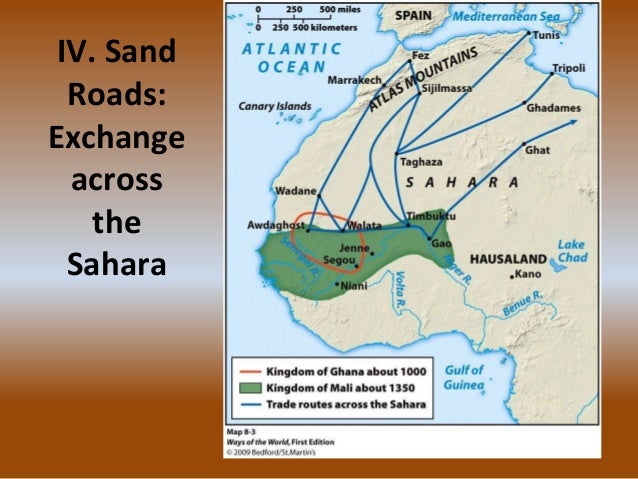
Sand Roads: Exchange across the Sahara
  • Sand Road commercial networks had a transforming impact, stimulating and enriching West African civilization 
Commercial Beginnings in West Africa
  • Trans-African trade was rooted in environmental variation
  • The great Sahara held deposits of copper and especially salt, while its oases produced sweet and nutritious dates
Gold, Salt, and Slaves: Trade and Empire in West Africa
  • What they sought was gold, which was found in some abundance in the border areas straddling the grasslands and the forests of West Africa
  • This long distance trade across the sahara provided both incentives and resources for the construction of a new and larger political structure 
  • Royal women played important political roles in many places; and oral traditions and mythologies frequently portrayed a complementary rather than hierarchical relationship between the sexes