Sunday, November 6, 2016

Week Ten: Due November 7th

DUE NOVEMBER 7:  READ & BLOG ON Chapter 8 (China and the World)
Chapter Eight: China and the World: East Asian Connections
Together Again: The reemergence of a Unified China
  • Substantial Chinese migration southward toward the Yangzi River Valley, a movement of people that gave southern China 60 percent of the country's population by 1000
  • Vast environmental transformation, marked by the destruction of the old-growth forces that once covered much of the country and the retreat of the elephants that had inhabited those lands 
A "Golden Age" of Chinese Achievements
  • China regained its unity under Sui Dynasty 
  • Its emperors solidified that unity by a vast extension of the country's canal system - those canals linked northern and southern China economically and contributed much to the prosperity that followed 
  • The ruthlessness of Sui emperors and a futile military campaign to conquer Korea exhausted the state's resources, alienated many people, and prompted the overthrow of the dynasty
  • Tang and Song Dynasty
  • Culturally, this era has long been regarded as a "golden age" of arts and literature, setting standards of excellence in poetry, landscaping, painting, and ceramics
  • Particularly during the Song Dynasty, an explosion of scholarship gave rise to Neo-Confucianism, an effort to revive Confucian thinking while incorporating into it some of the insights of Buddhism and Daoism
  • Politically, the Tang and Song Dynasties built a state structure that endured for a thousand years
  • Ability to print books for the first time in world history
  • A leading world historian has described Tang dynasty China as the best ordered state in the world 
  • The most obvious sign of China's prosperity was its rapid growth in population, which jumped from about 50 million or 60 million during the Tang Dynasty to 120 million by 1200
  • Adoption of fast ripening and drought resistant strain of rice from Vietnam 
  • Industrial production soared. In both large scale enterprises employing hundreds of workers and in smaller backyard furnaces, China's iron industry increased its output dramatically
  • Its navigational and shipbuilding technologies led the world
  • Chinese invention of gunpowder created within a few centuries of revolution in military affairs that had global dimensions
  • Output increased, population grew, skills multiplied, and a burst of inventiveness made Song China far wealthier than ever before - or than any of its contemporaries
Women in the Song Dynasty
  • Elite Women of the Tang Dynasty era, at least in the north, had participated in social life with greater freedom than in earlier times
  • Paintings and statues show aristocratic women riding horses, while Queen Mother of the West, a Daoist deity, was widely worshipped by female daoist priests and practitioners
  • Song Dynasty - tightened patriarchal restrictions on women and restored some of the earlier Han dynasty notions of female submission and passivity 
  • Writers highlights the subordination of women to men and the need to keep males and females separate in every domain of life 
  • For men, masculinity came to be defined less in terms of horseback riding, athleticism, and the warrior values of northern nomads and more in terms of the refined pursuits of calligraphy, scholarship, painting and poetry 
  • Corresponding views of feminine qualities emphasized women's weakness, reticence, and delicacy. Women were also frequently viewed as a distraction to men;s pursuit of a contemplative and introspective life
  • Foot binding.
  • Strongly urged the education of women, so that they might more efficiently raise their sons and increase the family's fortune
The Tribute System in Theory
  • That understanding cast China as the middle kingdom and the center of the world, infinitely superior to the barbarian peoples beyond its borders - China represented civilization
  • Tribute System - set of practices that required non-Chinese authorities to acknowledge Chinese superiority and  their own subordinate place in a Chinese-centered world order 
  • Foreigners seeking access to china had to send a delegation to the Chinese court - in return for these expressions of submission, he would grant permission for foreigners to trade in China's rich markets and would provide them with gifts often worth far more than the tribute they offered
The Tribute System in Practice
  • On Occasion, China was confronting not separate and small-scale barbarian societies, but large and powerful nomadic empires able to deal with China on at least equal terms
  • Xiongnu - equal, China gifted in return of protection
  • Despite the rhetoric of the tribute system, the Chinese were not always able to dictate the terms of their relationship with the northern nomads
  • The practice of bestowing gifts on barbarians, long a part of the tribute system, allowed the proud Chinese to imagine that they were still in control of the situation even as they were paying heavily for protection from nomadic incursion - those gifts in turn, provided vital economic resources to nomadic states 
Coping with China: Comparing Korea, Vietnam, and Japan
  • While resisting Chinese political domination, they also appreciated Chinese culture and sought the source of Chinese wealth and power
Korea and China
  • Some Korean customs - funeral rites in which the husband was buried in a sacred plot of his wife family, the remarriage of the widowed or divorced women, and female inheritance of property- coded under pressure of Confucian orthodoxy 
  • Korea's aristocratic class was able to maintain an even stronger monopoly on bureaucratic office than their Chinese counterparts
  • Korea moved toward greater cultural independence by developing a phonetic alphabet for writing the Korean Language
  • Clearly part of the Chinese world order, Korea nonetheless retained a distinct culture as well as a operate political existence 
Vietnam and China
  • The Vietnamese were ruled by the Chinese officials who expected to fully assimilate this rich rice-growing region into China culturally as well as politically 
  • Chinese replaced the local language in official business; Chinese clothing and hairstyles became mandatory 
  • A Chinese based examination system in Vietnam functioned to undermine an established aristocracy, to provide some measure of social mobility for commoners, and to create a merit-based scholar-gentry class to staff the bureaucracy 
  • There remained much that was uniquely Vietnamese: distinctive language, fondness of cockfighting, habit of chewing betel nuts
  • Vietnam long retained a greater role for women in social and economic life, despite heavy Chinese influence 
Japan and China
  • Japan's distance from China enabled it to maintain its political independence and to draw selectively from Chinese culture
  • Japan's extensive borrowing from Chinese civilization was wholly voluntary, rather than occurring under conditions of direct military threat or outright occupation
  • The state found much that was useful in Tang Dynasty China and set out, deliberately and systematically, to transform Japan into a centralized Bureaucratic state on the Chinese model
  • Japanese authorities adopted Chinese style court rituals and a system of court rankings for officials as well as the Chinese Calendar
  • They likewise established Chinese-based taxation systems, law codes, government ministries, and provincial administration, at least on paper
  • The absence of any compelling threat from China made it possible for the Japanese to be selective in their borrowing 
  • Japan's women largely escaped the more oppressive features of Chinese Confucian culture
  • Japanese women continued to inherit property, often lived apart or with the wife's family, and marriages were made and broken easily
Spillovers: China's Impact on Eurasia 
  • One of the outcomes of China's economic revolution lay in the diffusion of its many technological innovations to peoples and places far from East Asia as the movements of traders, soldiers, slaves, and pilgrims conveyed Chinese achievements abroad
  • Producing Salt, Paper making, Printing - Chinese innovations of revolutionary and global dimensions
  • China's prosperity during the Song dynasty greatly stimulated commercial life and market based behavior all across Afro-Eurasian trading world
On the Receiving End: China as Economic Beneficiary
  • Impact of China's involvement with a wider world derived from its growing participation in Indian Ocean Trade
Making Buddhism Chinese
  • Initially entered China via the Silk Road trading network during the first and second centuries 
  • The stability and prosperity ensured the new barbarian religion held little appeal for native Chinese
  • Buddhism took a solid root in China within both elite and popular culture, becoming a permanent, though fluctuating, presence in Chinese life

Week Nine: Due November 2nd

DUE NOVEMBER 2:  READ Chapter 10 (The Worlds of Christendom) BLOG ON the readings for this week.
Chapter 10: The Worlds of Christendom: Contraction, Expansion and Division
Asian Christianity
  • Much depended on the attitudes of local Muslim rulers. On occasion churches were destroyed, villages plundered, fields burned, and Christians forced to wear distinctive clothing
  • Nestorian Church had taken roots in China with the approval of the country's Tang dynasty rulers. Both its art and literature articulated the Christian message using Buddhist and Daoist concepts
  • The Mongol conquest of China in the thirteenth century offered a brief opportunity for Christianity's renewal, as the religiously tolerant Mongols welcomed Nestorian Christians as well as other faith
African Christianity
  • Found themselves on the defensive and declining in the face of an expanding Islam
  • Egypt christianity had become the religion of majority by the time of the Muslim conquest
  • Ethiopian Christianity developed some of its most distinctive features. Fascination with Judaism and Jerusalem, reflected in a much told story about the visit of the Ethiopian Queen of Sheba to King Solomon
Byzantine Christendom: Building on the Roman Past
  • Diverging histories of the Byzantine Empire and Western Europe took shape
  • Byzantine - continuing of Roman Empire
  • Byzantine consciously sought to preserve the legacy of Classical-Greco Roman civilization 
The Byzantine State
  • Political Authority remained centralized in Constantinople, where the emperor claimed to govern all creation as Gods worldly representative, styling himself the "peer of Apostles" and the  "sole ruler of the World"
The Byzantine Church and Christian Divergence
  • Tied the State to the Church - Caesaropapism 
  • Provided a cultural identity for subjects - they were orthodox, right thinking
  • Growing religious divergence reflected the political separation and rivalry between the Byzantine empire and the emerging kingdom of Western Europe
  • Beyond political differences were those of language and culture
  • Mutual misunderstanding and disdain 
Byzantium and the World
  • Interacted intensely with neighbors
  • Greek Fire- a potent and flammable combination of oil, sulfur, and lime that was launched form bronze tubes
  • Economically - was a central player in long distance trade of Eurasia 
  • Silk industry, luxurious products of Byzantine craftspeople - were in high demand
  • developed alphabet based on greek letters
  • This cyrillic script made it possible to translate the bible and other religious literature into these languages and greatly aided the process of conversion
The Conversion of Russia 
  • Religion reflected the regions cultural diversity, with the Gods and practices of many peoples much in evidence 
  • Political and commercial considerations no doubt played a role in Vladimir's decision, and he acquired a sister of the Byzantine emperor as his bride, along with numerous Byzantine priests and advisors
Western Christendom: Rebuilding in the Wake of Roman Collapse
  • The western half of the European Christian would followed a rather different path than that go the Byzantine Empire. Form much of the third-wave millennium, it was distinctly on the margins of world history, partly because of its geographic location at the far western end of the Eurasian landmass 
  • Extensive coastlines, and interior river systems facilitated exchange within Europe, while a moderate climate, plentiful rainfall, and fertile soils enabled a productive agriculture that could support a growing population
Society and the Church
  • A highly fragmented and decentralized society widely known as feudalism emerged with great local variation 
  • Women generally were required to weave cloth and make clothing for the lord, while some men labored in the lord's fields
  • In return the serf family received a small farm and such protection as the lord could provide
Accelerating Change in the West
  • The increased production associated with this agricultural expansion stimulated a considerable growth in long distance trade, much of which had dried up in the aftermath of the roman collapse
  • Sign of accelerating change - growth of territorial states with more effective institutions of government commanding the loyalty, or at least obedience, of their subjects
  • Economic growth and urbanization initially offered European women substantial new opportunities 
  • Women were active in a number of urban professions, such as weaving, brewing, milling grain, midwifery, small scale retailing, laundering, spinning, and prostitution
  • In England, women worked as silk weavers, haymakers, tailors, brewers, and leather processors and were entitled to train female apprentices in some of these trades
  • The church had long offered some women to an alternative to home, marriage, family, and rural life
  • Tightening male control of women took place in Europe as it had in Song Dynasty China at about the same time
  • "He was a good provider; he knew how to rake in the money and how to save it" PG 484
Europe Outward Bound: The Crusading Tradition
  • Expansion has been characteristic of virtually every civilization and has taken a variety of forms - territorial conquests, empire building, settlement of new lands, vigorous trading initiatives, and missionary activity 
  • The crusades had little lasting impact, either politically or religiously
Catching Up
  • Europeans fascination with technology and their religious motivation for investigating the world was apparent
  • Technological borrowing also was evident in the arts of war
  • Europe'e passion for technology was reflected in its culture and ideas as well as in its machines
Pluralism in Politics
  • Three way struggle for power among kings, warrior aristocrats, and church leaders, all of them from the nobility, enabled urban -based merchants in Europe to achieve an unusual independence from political authority
  • The relative weakness of Europe's rulers allowed urban merchants more leeway and, according to some historians, paved the way to a more thorough development of capitalism in later centuries
Reason and Faith
  • Distinctive intellectual tension between claims of human reason and those of faith

Week Nine: Due October 31st

DUE OCTOBER 31:  READ Chapter 9 (The Worlds of Islam)
Chapter Nine: The Worlds of Islam: Afro Eurasian Connection
The Birth of a New Religion
The Homeland of Islam 
  • Fiercely independent clans and tribes, which often engaged in bitter blood feuds with one another
  • Qurayash 
  • It might have seemed that Arabs w ere moving towards Judaism religiously or that Christianity, the most rapidly growing religion in Western Asia, would encompass Arabia as well 
The Messenger and the Message 
  • Muhammad 
  • Had a powerful, religious experience that left him convinced that he was allahs messenger to the arabs 
  • Quran 
The Transformation of Arabia
  • Umma - kind of super tribe 
  • In medina, Muhammad not only began to create a new society but also declared his movements independence from its earlier affiliation with Judaism 
  • Muhammad was not only a religious figure but also, unlike Jesus or Buddha, a political and military leader able to implement his vision of an ideal Islamic society
The Making of an Arab Empire 
  • Bound by the ties of a common faith but divided by differences of culture, class, politics, gender, and religious understanding 
War, Conquest, and Tolerance 
  • Arab armies engaged the Byzantine and Persian Sassanid Empires, the great powers region
  • Sassanid empire had been destroyed by the arabs and the Byzantine lost southern half of territory 
  • The Arab rulers of an expanding empire sought to limit the disruptive impact of conquest. The prevent indiscriminate destruction and exploitation of conquered peoples, occupying Arab armies were restricted to garrison towns, segregated from the native people 
Conversion 
  • Islam was, from the beginning, associated with the sponsorship of a powerful state
  • Conversion was not an automatic or easy process. Vigorous resistance delayed conversion for centuries among the berbs of North America 
  • "The Persians ruled for a thousand years and did not need us arabs even for a day. We have been ruling them for one or two centuries and cannot do without them for an hour"

Divisions and Controversies 
  • In the beginning this divide was simply a political conflict without serious theological or religious meaning. Overtime it acquired deeper significance
  • Sunni Muslims - religious authority in general emerged from the larger community, particularly from religious scholars known as Ulama 
  • Shia Muslims -  invested their leaders with a religious authority that the caliphs lacked ; infallibly interpret divine revelation and law 
  • Dynastic rivalries and succession disputes common to other empires
  • Despite differences, the legalistic emphasis of the ulama and Sufi spirituality never became irreconcilable versions of Islam
Women and Men in Early Islam 
  • Quran specific - men and women equal 
  • Social view- men have authority over the women 
  • Men were strongly encouraged to marry orphans, widows, and slaves 
  • Men were limited to four wives and required to treat them all equally
  • Men were permitted to have sexual relations with slaves, but any children are born free
  • Signs of Tightening patriarchy - honor killing of women by their relatives for violating sexual taboos 
  • Negative Views of Women
Islam and Cultural Encounter: A Four-Way Comparison 
The Case of India
  • Muslims usually lived quite separately, remaining a distinctive minority within an ancient Indian civilization, which they now largely governed by which they proved to completely transform 
The Case of Anatolia
  • Modern Turkey
  • By 1500 the population was 90 percent Muslim and largely Turkie-speaking, and Anatolia was the heartland of the powerful Turkish Ottoman Empire that had overrun Christian Byzantium
  • The turkish rulers of Anatolia built a new society that welcomed converts and granted them material rewards and opportunity for high office
The Case of West Africa 
  • Islamic accompanied Muslim traders across the Sahara rather than being brought by invading Arab or Turkic armies
  • For African merchant communities, Islam provided an important link to Muslim trading partners, much as Buddhism had done in Southeast Asia 
  • S number of West African cities had become major centers of Islamic religious and intellectual life, attracting scholars from throughout the Muslim World
  • Islam remained the culture of urban elites and little into the rural areas of West Africa
The Case of Spain
  • The chief site of Islamic encounter with Christian Europe occurred in Spain
  • Spains agricultural economy was the most prosperous in Europe during this time and its capital was among the largest and most splendid cities in the world
  • Many of the remaining Christians learned Arabic, veiled their women, stopped eating pork, appreciated Arabic music and poetry, and sometimes married Muslims
  • So called golden age of Muslim Spain was both limited and brief
  • Intolerance intensified as the Christian reconquest of Spain gained ground 
  • After the conquest, many Muslims were forced to emigrate, replaced by Christian settlers 
  • While those who remained under Christian rule were legally guaranteed freedom of worship, they were forbidden to make converts, to give call to prayer, or to go on pilgrimage 
  • Thus Spain, unlike most other regions incorporated into the Islamic World, experienced a religious reversal as Christian rule was reestablished and Islam painfully eradicated from the Iberian Peninsula 
Networks of Faith
  • At the core of that vast civilization was a common commitment to Islam. No group was more important in the transmission of those beliefs and practices than the ulama
  • The ulama were an international elite and the system of education they created served to bind together an immerse and diverse civilization 
  • Common texts were shared widely across the world of Islam
  • Grand pilgrimage to Mecca
  • The claims of local identities based on family, clan, tribe, ethnicity, or state never disappeared, but now overarching them all was the inclusive unity of the Muslim community
Key Achievements in Islamic Science and Scholarship
  • al-Khwarazim: Mathematician; spread use of Arabic numerals in Islamic world; wrote first book on algebra
  • al-Razi: Discovered sulfuric acid; wrote a vast encyclopedia of medicine drawing on Greek, Syrian, Indian, and Persian work and his own clinical observation 
  • al-Biruni: Mathematician, astronomer, cartographer; calculated the radius of the earth with great accuracy; worked out numerous mathematical innovations; developed a technique for displaying a hemisphere on a plane
  • Ibn Sina: Prolific writer in almost all fields of science and philosophy; especially known for Canon of Medicine, a fourteen-volume work that set standards for medical practice in Islamic and Christian worlds for centuries 
  • Omar Khayyam: Mathematician; critic of Euclid's geometry; measured the solar year with great accuracy Sufi poet; author of The Rubaiyat
  • Ibn Rushd: Translated and commented widely on Aristotle; rationalist philosopher; made major contributions in law, mathematics, and medicine
  • Nasir al-Din Tusi: Founder of the famous Maragha observatory in Persia; mapped the motion of stars and planets
  • Ibn Khaldun: Greatest Arab historian; identified trends and structures in world history over long periods of time


Week Eight: Due October 26th

DUE OCTOBER 26:  READ & BLOG ON Intro to Part Three & Ch 7
Chapter Seven: Commerce and Culture
Silk Roads: Exchange across Eurasia
  • These land based trade routes linked pastoral and agricultural peoples as well sas the large civilization on the continents outer rim 
The Growth of the Silk Roads
  • Silk Road trading networks prospered most when large and powerful states provided security for merchants and travelers
  • Over many centuries, various technological innovations, such as yokes, saddles, and stirrups, made the use of camels, horses, and oxen more effective means of transportation across the cast distances of the Silk roads 
Goods in Transit
  • A vast array of goods made its way across the silk Roads, often carried in large camel caravans that traveled harsh and dangerous steppes, deserts, and oases of Central Asia 
  • Most of these goods were luxury products, destined for an elite and wealthy market, rather than staple goods, for only readily moved commodities of great value could compensate for high costs of transportation across such long and forbidding distances
Economic Exchange along the Silk Roads
  • China: silk, bamboo, mirrors, gunpowder, paper, rhubarb, ginger, lacquerware, chrysanthemums 
  • Forest Lands of Siberia and grasslands of Central Asia: furs, walrus tusks, amber, livestock, horses, falcons, hides, copper vessels, tents, saddles, slaves
  • India: cotton textiles, herbal medicines, precious stones, spices,
  • Middle East: dates, nuts, almonds, dried fruit, dyes, lapis lazuli, swords
  • Mediterranean Basin: gold coins, glassware, glazes, grapevines, jewelry, artworks, perfume, wool and linen textiles, olive oil
Cultures in Transit
  • Role as conduit of culture
  • Buddhism spread across the Silk Road from india to Central Asia
  • Doctrines changed as well
Disease in Transit
  • Diseases too traveled the trade routes of Eurasia, and with devastating consequences
  • Each of the major population centers of the Afro Eurasian world had developed characteristic disease patterns, mechanisms for dealing with them, and in some cases immunity to them
  • People were exposed to unfamiliar diseases for which they had little immunity or few effective methods of coping
  • Even more widespread diseases affected the Roman Empire and Han Dynasty China as the Silk Roads promoted contact all across Eurasia
  • Small pox and measles devastated the populations of both empires, contributing to their political collapse
  • The exchange of diseases gave Europeans a certain advantage when they confronted the people of the Western Hemisphere 
Sea Roads: Exchange across the Indian Ocean
  • Sea based trade routes connected distant peoples all across the Eastern Hemisphere 
  • Paralleling the Silk Road trading network, a sea based commerce in the indian ocean basin connected the many peoples between china and East Africa
  • What made Indian Ocean commerce possible were the monsoons, alternating wind currents that blew predictably eastward during the summer months, and westward during the winter
  • Indian Ocean commerce did not occur between entire regions and certainly not between countries 
Economic Exchange in the Indian Ocean Basin
  • Mediterranean Basin: ceramics, glassware, wine, gold, olive oil
  • East Africa: ivory, gold, iron goods, slaves, tortoiseshells, quartz, leopard skins
  • Arabia: Frankincense, myrrh, perfumes
  • India: Grain, ivory, precious stones, cotton textiles, spices, timber, tortoiseshells
  • Southeast Asia: Tin, sandalwood, cloves, nutmeg, mace
  • China: silks, porcelain, tea
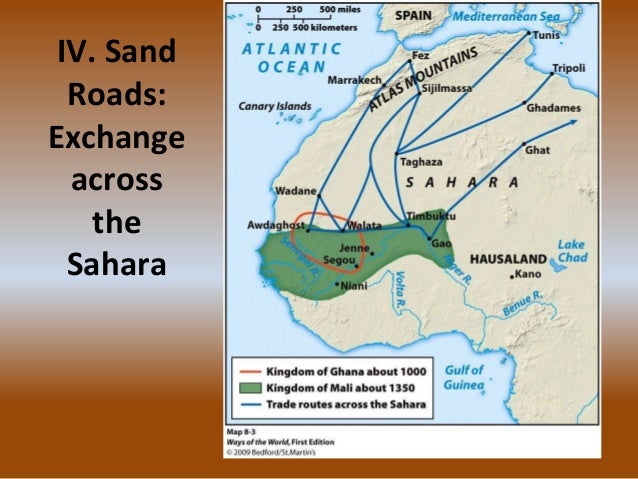
Sand Roads: Exchange across the Sahara
  • Sand Road commercial networks had a transforming impact, stimulating and enriching West African civilization 
Commercial Beginnings in West Africa
  • Trans-African trade was rooted in environmental variation
  • The great Sahara held deposits of copper and especially salt, while its oases produced sweet and nutritious dates
Gold, Salt, and Slaves: Trade and Empire in West Africa
  • What they sought was gold, which was found in some abundance in the border areas straddling the grasslands and the forests of West Africa
  • This long distance trade across the sahara provided both incentives and resources for the construction of a new and larger political structure 
  • Royal women played important political roles in many places; and oral traditions and mythologies frequently portrayed a complementary rather than hierarchical relationship between the sexes


Saturday, October 8, 2016

Week Seven: Due October 10th

READ & BLOG ON Chapter 6 (Classical Era Variations)
Chapter Six: Commonalities and Variations 
CONTINENTAL COMPARISONS 
  • Beginning in Africa, the fast movement of humankind subsequently encompassed  Eurasia, Australia, the Americas, and Pacific Oceania
  • That revolutionary transformation of human life subsequently generated, in particularly rich agricultural environments of all three regions, those more complex societies that we know as civilizations are great social inequality
  • The worlds human population was then distributed very unevenly across three giant continents. If these estimates are even reasonably accurate, then during the second wave of Eurasia was home to more than 80% of the worlds people
CIVILIZATIONS OF AFRICA
  • Many of these differences grew out of the continents environmental variations
  • Africa did, however, have one distinct environmental feature: bisected by the equator it was the most tropical of the worlds three sub continents
  • Persistent warm temperatures cause the rapid decomposition of vegetable matter called hummus resulting in poorer and less fertile soil's and the less productive agriculture than in the most temperament Eurasia
  • Those climatic conditions also sponsor numerous disease carrying insects in parasites
MEROË: CONTINUING A NILE VALLEY CIVILIZATION
  • The kingdom was governed by an all powerful and sacred monarch, a position held on at least 10 occasions by women, governing alone or is corulers with a male monarch
  • Queens appeared in sculptures as women and with a prominence in power equivalent to their male counterparts
  • In accordance with ancient traditions such rulers were buried along with a number of human sacrificial victims
  • The wealth and military power derived in part from extensive long-distance trading connections
  • Declined in part because of deforestation caused by the need for wood to make charcoal for smelting iron
AXUM: THE MAKING OF A CHRISTIAN KINGDOM
  • It's economic foundation was a highly productive agricultural that used a plow-based farming system unlike the rest of Africa which relied on a hoe or digging stick
  • The interior capital city was the center of monumental building and royal patronage for the arts
  • The most famous buildings were huge stone obelisks, which most likely marked royal graves. Some of them were more than 100 feet tall and at the time were the largest structures in the world hewn from a single piece rock
  • Was introduced to Christianity in the fourth century. It's monarch at the time adopted the new religion about the same time as Constantine did in the Roman Empire
  • Christianity maintained a dominant position in the mountainous terrain of highland Ethiopia and in the early 21st-century still represents the faith of perhaps 60% of the countries population
ALONG THE NIGER RIVER: CITIES WITHOUT STATES
  • Apparent absence of a corresponding state structure
  • Niger urban centers were not encompassed within some larger imperial system 
  • Cities without citadels - complex urban centers that apparently operated without the coercive authority of the state
  • These urban centers resemble the early cities of the Indus valley civilization where likewise little archeological evidence of centralized state structures have been found
CIVILIZATIONS OF MESOAMERICA
  • Aztec and Inca empires 
  • despite this diversity, Mesoamerica was also a distinct region, bound together by the elements of a common culture
  • They practiced religions featuring a similar pantheon of male and female deities understood as a cosmic cycle of creation and destruction
THE MAYA: WRITING AND WARFARE
  • Scholars of traced the beginnings of a Maya people to ceremonial centers constructed as early as 2000 B.C.E. in present day Guatemala and a region of Mexico 
  • Their most well-known culture achievements emerged 
  • Intellectuals developed a mathematical system that included the concept of zero and place notation and was capable of complex calculations
  • Carved on stone and written on bark paper or deerskin books, Mayan writing recorded historical events, masses of astronomical data, and religious or mythological texts
TEOTIHUACÁN: THE AMERICAS' GREATEST CITY
  • It was by far the largest urban complex in the Americas it in one of the six largest in the world
  • Physically the city was enormously impressive, replete with broad Avenues, spacious plazas, huge marketplaces, temples, palaces, apartment complexes,  waterways, reservoirs, drainage systems, and colorful murals 
  • You images of self glorifying rulers or individuals
  • At least some of this political and military activity was no doubt designed to obtain either by trade or by tribute commodities from afar
CIVILIZATIONS OF THE ANDES
  • Bleak deserts along the coast supported human habitation only because they were cut by dozens of rivers flowing down from the mountains offering the possibility of irrigation and cultivation
  • Incas
CHAVÍN: A PAN-ANDEAN RELIGIOUS MOVEMENT 
  • Small center had become town of 2000 to 30000 people, with clear distinctions between an elite class, who lived in stone houses, and ordinary people, with adobe dwellings
  • This blended religious movement proved attractive across much of Peru and beyond
  • Although some evidence suggests violence and warfare, no chavin empire emerged
  • Instead, a widespread religious cult, erected on the back of a trading network 
  • Provided for the first time and for several centuries a measure of economic and cultural integration to much of the Peruvian Andes 
MOCHE: A CIVILIZATION OF THE COAST 
  • Their economy was rooted in a complex irrigation system, requiring constant maintenance 
  • Governed by warrior priests
  • Shaman rulers conducted ancient rituals that mitigated between the world of humankind and that of the gods
  • They also presided over the ritual sacrifice of human victims which became central to the politico religious life
  • The cultural achievements rested on fragile environmental foundations for the region is subject to dry out earthquakes in occasional torrential rains associated with El Niño episodes
WARI AND TIWANAKU: EMPIRES OF THE INTERIOR
  • Provided a measure of political integration and cultural commonality for the entire Andean region
  • Going out of ancient settlements these two states floors between 400 and 1000 CE one in the Northern Highlands and one to the south
  • Both governments collected surface food and warehouses as an insurance against times of drought and famine
  • Neither state controlled a continuous band of territory
  • Little overt conflict or warfare occurred between the two empires
ALTERNATIVES TO CIVILIZATIONS: BANTU AFRICA
  • Movement of people is generated from some 400 distinct but closely related languages
  • Bantu expansion is not a conquest or invasion such as that Alexander great nor was it as massive been self-conscious migration like that of Europeans to the Americas in more recent times
  • It was a slow movement of peoples but taken as a whole it brought to Africa south of the equator a measure of cultural and linguistic commonality
CULTURAL ENCOUNTERS
  • The movement generated numerous cross-cultural  encounters

Wednesday, October 5, 2016

Week Six: Due October 5th

DUE OCTOBER 5:   READ Chapter 5 & BLOG ON the readings for this week
Chapter Five: Society and Inequality in Eurasia/ North Africa 
SOCIETY AND THE STATE IN CHINA
  • Political power and immense social prestige of Chinese state officials, all of them male
  • As the Han Dynasty established its authority in China around 200 BCE, its rulers required each province to send men of promise to the capital, where they were examined and chosen for the official positions on the basis of their performance
AN ELITE OF OFFICIALS
  • Over time, this stream of selecting administrators revolved into the worlds first professional civil service
  • Private schools in the provinces funneled still more aspiring candidates into this examination system 
  • In theory open to all men, this system in practice favored those whose families were wealthy enough to provide the years of education required to pass even the lower level exams
  • The examination system provided a modest measure of social mobility in an otherwise quite hierarchical society
  • Those who made it into the bureaucracy entered a realm oh high privilege and great prestige 
THE LANDLORD CLASS
  • Most officials came from wealthy families, and in China wealth meant land 
  • This accumulation of land in seizable estates was a persistent theme in Chinese history, and one that was frequently, though not very successful, opposed by state authorities 
  • The fate of individual families rose and fell as the wheel of fortune raised them to great prominence or plunged them into poverty and disgrace 
  • The term scholar-gentry reflected their twin sources of privilege 
PEASANTS
  • The vast majority of its population consisted of peasants, living in small households representing two or three generations 
  • Such conditions provoked periodic peasant rebellions 
  • Yellow Turban Rebellion
  • Repeatedly in Chinese history, such peasant movements often expressed in religious terms, registered the sharp class antagonisms of Chinese society that led to the collapse of more than one ruling dynasty 
MERCHANTS
  • Peasants were the solid productive backbone of the country, and their hard work and endurance in the face of difficulties were worthy of praise 
  • Merchants were viewed as unproductive, making a shameful profit from selling the work of others
  • Seen as a social threat
CLASS AND CASTE IN INDIA
  • In both civilizations, birth determined social status for most people; little social mobility was available for the vast majority; sharp distinctions and great inequalities characterized social life; and religious or cultural traditions defined these inequalities as natural, eternal, and ordained by the Gods 
CASTE AS VARNA 
  • The caste evolved from a racially defined encounter between light skinned aryan invaders and the darker hued native peoples
  • The idea that society was forever divided into four ranked classes, or varnas, was deeply embedded in Indian thinking. 
  • At the top were priests, followed by warriors and rulers, next was commoners, far below these was the servants 
CASTE AS JATI
  • The many thousands of jatis became the primary cell of India's unique caste-based society 
  • Marriage and eating together were permitted only within an individuals own jati
  • With its many desperate, distinct, and hierarchically ranked social groups, Indian society was quite different from that of China 
  • Being born into a particular caste was generally regarded as reflecting the good or bad deeds of a previous life 
  • As caste restrictions tightened, it became increasingly difficult for individuals to raise their social status during their lifetimes
  • India’s social system thus differed from that of China in several ways. It gave priority to religious status and ritual purity, whereas china elevated political officials to the highest of elite positions 
THE FUNCTIONS OF CASTE 
  • Provided a substitute for the state as an integrative mechanism for Indian civilization 
  • It offered a distinct and socially recognized place for almost everyone 
  • Caste represented a means of accommodating the many migrating or invading peoples who entered the subcontinent 
  • Allowed people to find a place within a larger Indian civilization while retaining something of their unique identity 
SLAVERY: THE CASE OF THE ROMAN EMPIRE
  • A social institution with deep roots in human history 
  • The class inequalities of early civilizations, which were based on great differences in privately owned property, also made it impossible to imagine people owning other people 
SLAVERY AND CIVILIZATION
  • Slavery generally meant ownership by a master, eh  and possibility of being sold, working without pay, and the status of an outsider at the bottom of the social hierarchy 
  • In sometimes and places, a fair number of slaves might be emancipated in their own lifetimes, through the generosity of religious convictions of their owners, or to avoid caring for them in old age, or by allowing slaves to purchase their freedom with their own funds 
  • Varied considerably in the labor they were required to do 
  • People could fall into slavery as criminals, debtors, or prisoners of war 
THE MAKING OF ROMAN SLAVERY
  • Greco-Roman Society based on slavery 
  • Aristotle- slaves by nature, should be enslaved for own good
  • Vast majority prisoners of war
  • Romans regarded their slaves as barbarians 
RESISTANCE AND REBELLION
  • The slaves themselves rose to rebellion
  • Spartacus 
  • Haitian rebels sought the creation of a new society free of slavery altogether 
COMPARING PATRIARCHIES
  • Women's subordination in all civilizations has been so widespread and pervasive that historians have been slow to recognize that gender systems has a history, changing over time 
  • Restrictions on women were far sharper in urban based civilizations
A CHANGING PATRIARCHY: THE CASE OF CHINA
  • Yang viewed as masculine and related to heaven, rulers, strength, rationality, and light
  • Yin, the lower feminine principle, was associated with the earth, subjects, weakness, emotion, and darkness
  • Men go out, women stay in 
  • Three obediences - women's subordination to her father, then husband, and finally her son
CONTRASTING PATRIARCHIES: ATHENS AND SPARTA
  • Athens has been celebrated as a major expression of democracy and rationalism, its treatment toward women was far more restrictive than that of the highly militaristic and much less democratic Sparta

Sunday, September 25, 2016

Week Five: Due September 26

DUE SEPTEMBER 26:  READ & BLOG ON Intro to Part Two & Ch 3 (State & Empire)
Part Two: Second Wave Civilizations in World History 
The Big Picture: After the First Civilizations: What Changed and What Didn't?
  • The entire age of agricultural civilizations 
  • Civilization as a form of human community proved durable and resilient as well as periodically fragile
Continuities in Civilization 
  • States and empires rose and expanded 
  • No technological or economic breakthrough occurred to create new kinds of human societies 
  • Many fluctuations, repetitive cycles, and minor changes characterized this long era of agricultural civilization, but no fundamental or revolutionary transformations of social or economic life took place
Changes in Civilization
  • Population grew more rapidly 
  • The rate of growth, though rapid in comparison to recent centuries, was quite slow if we measure it against the expansion of recent centuries
  • The rise and Fall of these empires represented very consequential changes to the people who experienced them
Chapter Three: State and Empire in Eurasia/North America
  • The United States' enormous multicultural society, its technological achievements, its economically draining and overstretched armed forces, its sense of itself as unique and endowed with a global mission, its concern about foreigners penetrating its borders, its apparent determination to maintain military superiority - all of this invited comparison with the Roman empire
Empires and Civilizations in Collision: The Persians and the Greeks
  • These distant civilizations did not directly encounter one another, as each established its own political system, cultural values, and ways of organizing society
  • Emerging Personal Empire and Greek civilization, physically adjacent to each other, experienced a centuries long interaction and clash
The Persian Empire
  • Persian conquests quickly reached reached from Egypt to India, encompassing in a single state some 35 to 50 million people, an immediately diverse realm containing dozens of people, states, languages, and cultural traditions
  • The Persian Empire centered on an elaborate cult of kingship in which the monarch, secluded in royal magnificence, could be approached only through an elaborate ritual 
  • Persians were expected to shave their head in mourning
  • Kings were absolute monarchs, more than willing to crush rebellious regions or officials 
  • An effective administrative system placed Persian governors in each of the empire's twenty-three provinces, while lower level officials were drawn from local authorities 
  • The infrastructure of empire included a system of standardized coinage, predicable taxes levied on each province, and a newly dug canal
The Greeks
  • Small competing city states of Greece, which allowed varying degrees of popular participation in political life 
  • The Greeks created a civilization that was distinctive in many ways, particularly in comparison with the Persians
  • Greek civilization took shape on a small peninsula deeply divided by steep mountains and valleys
  • Even though intense conflict with neighbors they put them aside every few years for olympics
  • The Greeks were expansive people, but there expansion took the form of settlement in distant places rather than conquest and empire 
  • Greatest contrast with Persia, lay in the extent of popular participation in political life that occurred with at least some of the city states
  • Compared to the rigid hierarchies, inequalities, and absolute monarchies of Persia and other ancient civilizations, the Athenian experiment was remarkable 
  • Athenian democracy was different from modern democracy. It was direct, rather than representative, democracy, and it was distinctly limited
Collision: The Greco-Persian Wars
  • If there was ever an unequal conflict between civilizations, it was the collision of the Greeks and Persians 
  • From the respective patterns of expansion 
  • Outraged by the assault from remote and upstart Greeks, the Persians, twice in ten years, launched major military expeditions to punish the greeks in general and Athens in particular. Against all odds and all expectations, the Greeks held them off, defeating the Persians on both land and sea.
  • The Greek victory also radicalized Athenian democracy, for it had been men of the poorer classes who had rowed their ships to victory and who were now in position to insist on full citizenship
  • Civil War with Sparta - Athens was defeated, while the Greeks exhausted themselves and magnified their distrust for one another
Collision: Alexander and the Hellenistic Era
  • Served to unify the fractions Greek in a war against their common enemy - Persia 
  • Ten-year expedition, accomplished while Alexander was in his twenties
  • Alexander was hailed as the King of Asia. In Egypt Alexander, 24, was celebrated as a liberator from Persian domination, was anointed as Pharaoh, and was declared by Egyptian priests to be son of the Gods 
  • Periodic rebellions expressed resentment at Greek arrogance, condescension, and exploitation 
  • Much of this Greek cultural influence faded as the Hellenistic kingdom that had promoted it weakened and vanished by the first century 
Comparing Empires: Roman and Chinese
  • They were the giant empires of their time, shaping the lives of close to half of the worlds population  
  • The Romans and the Chinese were only dimly aware of each other and had almost no direct contact 
Rome: From City-State to Empire 

  • An empire that encompassed the entire Mediterranean basin and beyond
  • The growth of the empire represented opportunity
  • Drawing on the growing population of Italy, that army was often brutal in war
  • A Roman woman could participate proudly in this warrior culture by bearing brave sons and inculcating this values in her offspring 
  • Upper class Roman women had never been as secluded in the home as were their Greek counterparts, and now the legal authority of their husbands was curtailed by the intrusion of the state into what had been private life
  • Roman women of the wealthier classes gained almost complete liberty in matters of property and marriage 
  • Roman conquests brought many thousands of men and women into the empire as slaves, often brutally treated and subject to the whims of their masters 
China: From Warring States to Empire
  • Shihuangdi launched a military campaign to unify China and in just ten years soundly defeated the other warring states
  • He laid the foundations for a unified Chinese state, which has endured, with periodic interruptions, to the present
  • Imposed a uniform system of weights, measures, and currency and standardized the length of axles for carts and the written form of the Chinese language 
  •  It was Han dynasty rulers who consolidated China's imperial state and established the political patterns that lasted into the twentieth century
Consolidating the Roman and Chinese Empires
The Collapse of Empires
  • Roman empire: The western half collapsed whereas the part maintained the tradition of imperial Rome
  • They both got too big, too overextended, and too expansive to be sustained by the available resources, and no fundamental technological breakthrough was available to enlarge these resources
  • The collapse of empire meant more than the disappearance of centralized government and endemic conflict
  • Also meant the decline of of urban life, a contracting population, less area under cultivation, diminishing international trade, and vast insecurity for ordinary people 
Intermitten Empire: The Case of India
  • Political fragmentation and vast cultural diversity
  • A distinctive religious tradition, Hinduism, and a unique social organization, the caste system
  • Despite there good intentions, these policies did not long preserve the empire, which broke apart soon after Ashoka's death 
  • The Gupta era witnessed a flourishing of art, literature, temple building, science, mathematics, and medicine, and much of it patronized by rulers
  • Its cotton textile industry long supplied cloth throughout the Afro Eurasian world